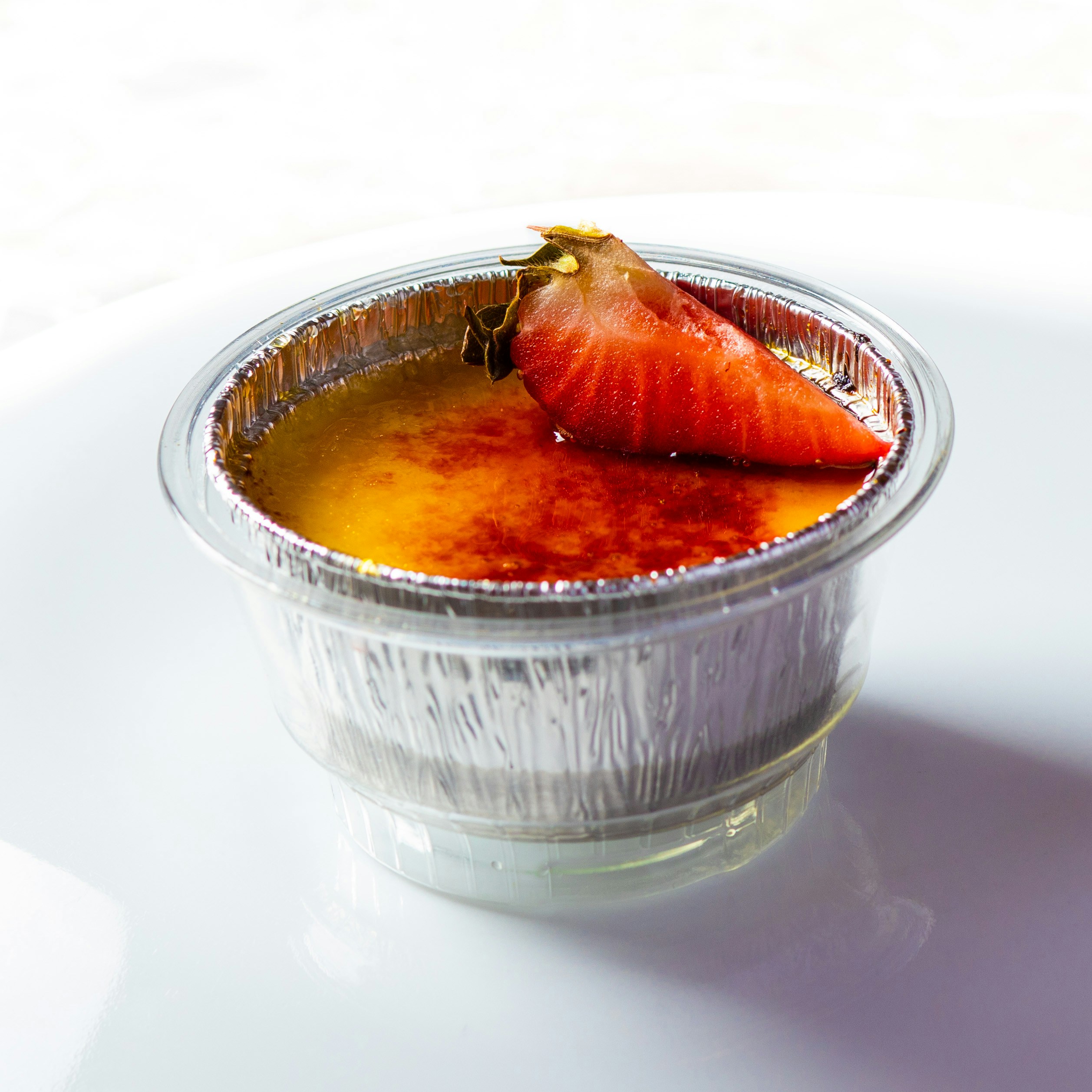
Few confections in classical French pastry showcase the intersection of fluid mechanics and high-heat thermodynamics as exquisitely as an authentic crème brûlée. Far surpassing ordinary stovetop puddings or gelatin-thickened creams, this iconic dessert pairs an impossibly silken, cool baked egg-custard core with an intensely hot, brittle sheet of pyrolyzed sucrose that shatters like tempered glass under the tap of a spoon.
The Molecular Architecture of Baked Custard & Pyrolysis
Because an authentic crème brûlée relies on neither starch (flour or cornstarch) nor gelatin for thickening, its velvet-like stability is dictated exclusively by the thermal suspension of yolk proteins and heavy milk fats:
- Egg Yolk Protein Denaturation: When egg yolks are subjected to gentle heat, their lipovitellin and phosvitin protein strands unravel and intertwine into a fragile, three-dimensional mesh that immobilizes free liquid and fat droplets. However, if the custard core temperature climbs beyond 175°F to 180°F (80°C to 82°C), these protein strands coagulate too tightly, expelling trapped moisture and producing grainy, sulfurous scrambled eggs.
- Thermal Moderation via Bain-Marie: Radiant oven air transfers energy unevenly, which quickly scorches the shallow perimeter of a ceramic dish. By resting the ramekins within a warm water bath, thermal conduction is buffered; liquid water cannot exceed its boiling threshold of 212°F (100°C), guaranteeing that ambient heat flows gently and uniformly through the ceramic walls.
- Sugar Pyrolysis vs. Melting: The signature glass-like surface is created by rapid surface pyrolysis—caramelization. Applying the concentrated, 2,500°F (1,370°C) blue flame of a butane culinary torch melts granulated sucrose crystals instantaneously into an amorphous liquid pool before thermal energy can penetrate downward to curdle the delicate, cold custard underneath.
Ingredients & Functional Chemistry
| Ingredient | Precise Quantity | Scientific & Culinary Contribution |
|---|---|---|
| Heavy Whipping Cream (36–40% Butterfat) | 2 cups (480ml) | Supplies rich dairy lipids that coat protein strands, yielding a silken mouthfeel and preventing premature curdling. |
| Whole Madagascar Vanilla Bean | 1 whole bean (split & scraped) | Releases complex lipid-soluble vanillin and aromatic phenolic volatiles during warm lipid infusion. |
| Large Fresh Egg Yolks | 5 large yolks (approx. 90g) | Provides natural lecithin to bind water and dairy fat, alongside proteins that coagulate into a tender, sliceable gel. |
| Granulated White Cane Sugar (Custard) | 1/3 cup (65g) | Dissolves into egg albumins, elevating the protein coagulation threshold to broaden the margin against curdling. |
| Fine Flaky Sea Salt | 1/8 teaspoon (pinch) | Suppresses bitter notes, balances intense dairy richness, and sharpens delicate vanilla aromatics. |
| Extra-Fine Granulated Sugar (Brulee Top) | 4 to 6 tablespoons (for topping) | Uniform micro-crystals melt rapidly and evenly under flame without leaving scorched bitter hot spots. |
Step-by-Step Culinary Protocol
Step 1: Lipid Infusion and Volatile Extraction
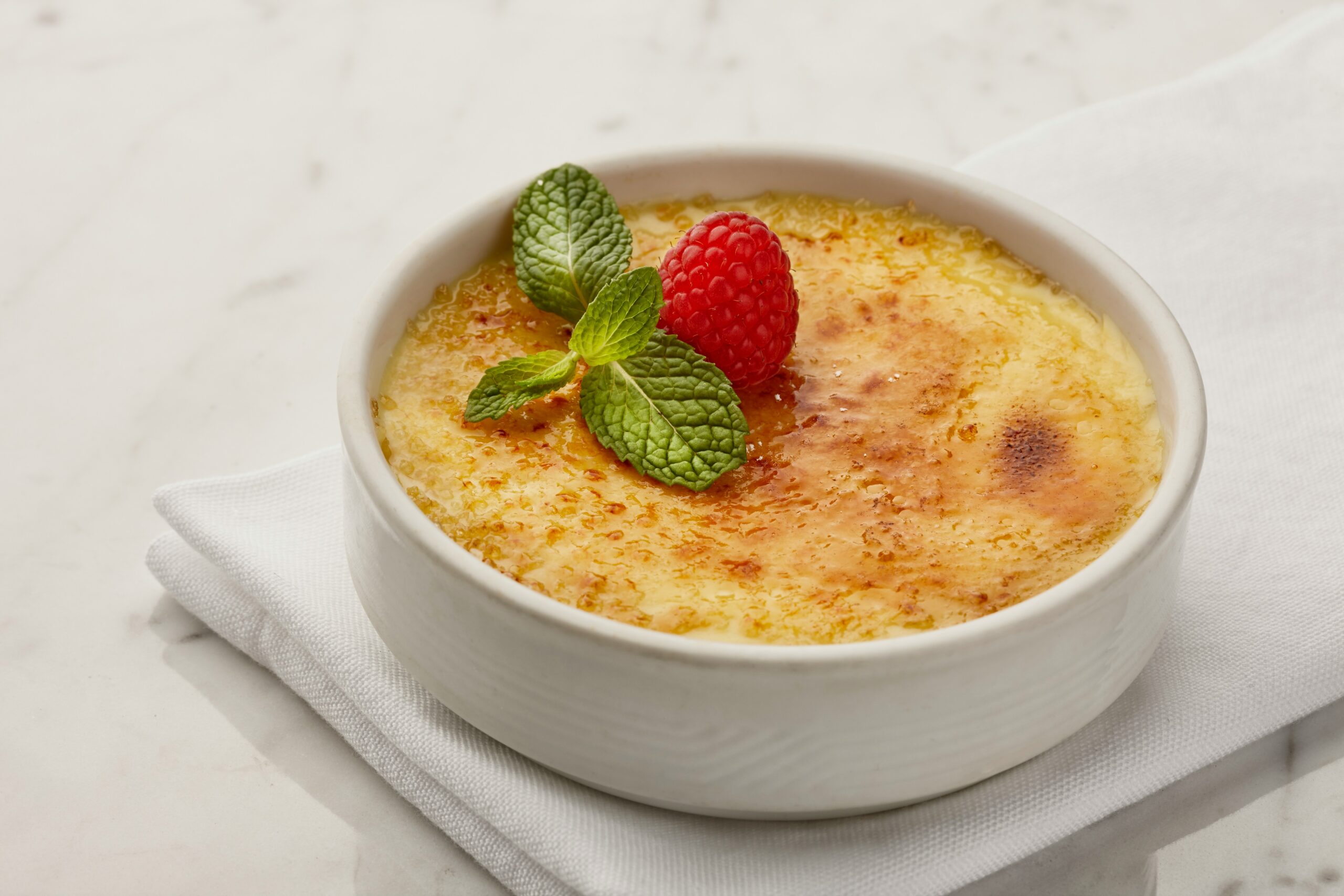
Preheat your oven to 325°F (160°C). Pour the heavy whipping cream and fine sea salt into a heavy-bottomed stainless steel saucepan. Using the tip of a paring knife, slice the whole Madagascar vanilla bean lengthwise and scrape the thousands of microscopic black caviar seeds directly into the cream; drop the spent fibrous pod in as well. Place the pan over medium heat until small bubbles form around the perimeter (approx. 175°F / 80°C). Remove from heat immediately, cover the saucepan tightly with a lid, and allow the lipids to absorb the delicate vanillin aromatics for 15 minutes.
Step 2: Low-Shear Egg Yolk Emulsification
In a medium heatproof glass mixing bowl, whisk together the fresh room-temperature egg yolks and granulated sugar. Whisk slowly and steadily by hand for 60 to 90 seconds just until the sugar crystals begin dissolving and the yolks lighten slightly in color. Never use an electric mixer or whisk vigorously; introducing trapped micro-air bubbles will ruin the mirror-smooth surface of the finished custard.
Step 3: The Tempering Cascade
Remove the spent vanilla pod from the warm cream. While whisking the egg yolk mixture continuously with one hand, slowly stream in 1/2 cup of warm cream to temper the yolks, gradually acclimating the egg proteins to the heat without shocking them into curds. Slowly pour in the remainder of the warm cream in a steady, thin ribbon, maintaining continuous gentle whisking until the custard is homogenous.
Step 4: Micro-Straining and De-Aeration
Pour the warm custard mixture through a fine-mesh drum sieve into a large, spouted glass measuring vessel. This critical filtration removes chalazae (egg cord fragments), un-dissolved egg strands, and spent pod fibers. If any foam or micro-bubbles linger on the surface, sweep a clean paper towel across the top or pass the flame of a kitchen torch lightly over the surface to pop the bubbles instantly.
Step 5: The Submerged Bain-Marie Bake
Arrange four to six shallow 5-ounce (150ml) ceramic ramekins inside a heavy, high-sided roasting pan. Divide the strained custard evenly among the ramekins. Transfer the roasting pan onto the middle oven rack. Carefully pour boiling kettle water into the empty corners of the outer roasting pan until the water level reaches halfway up the exterior sides of the ramekins. Bake for 30 to 35 minutes at 325°F (160°C). The custards are perfectly set when the outer edges are firm, but the center two inches remain gently trembling and jelly-like when nudged.
Step 6: Gradual Thermal Stabilization & Chilling
Carefully lift the ramekins out of the hot water bath using canning tongs or kitchen towels and arrange them on a wire cooling rack. Allow them to drop to ambient room temperature for 1 hour. Transfer the ramekins uncovered into the refrigerator and chill for a minimum of 4 hours (optimally 8 to 12 hours). Cold storage solidifies the butterfat networks, allowing the custard to reach its definitive velvety consistency before firing.
Step 7: Precision Pyrolysis (The Brûlée Glass Shatter)
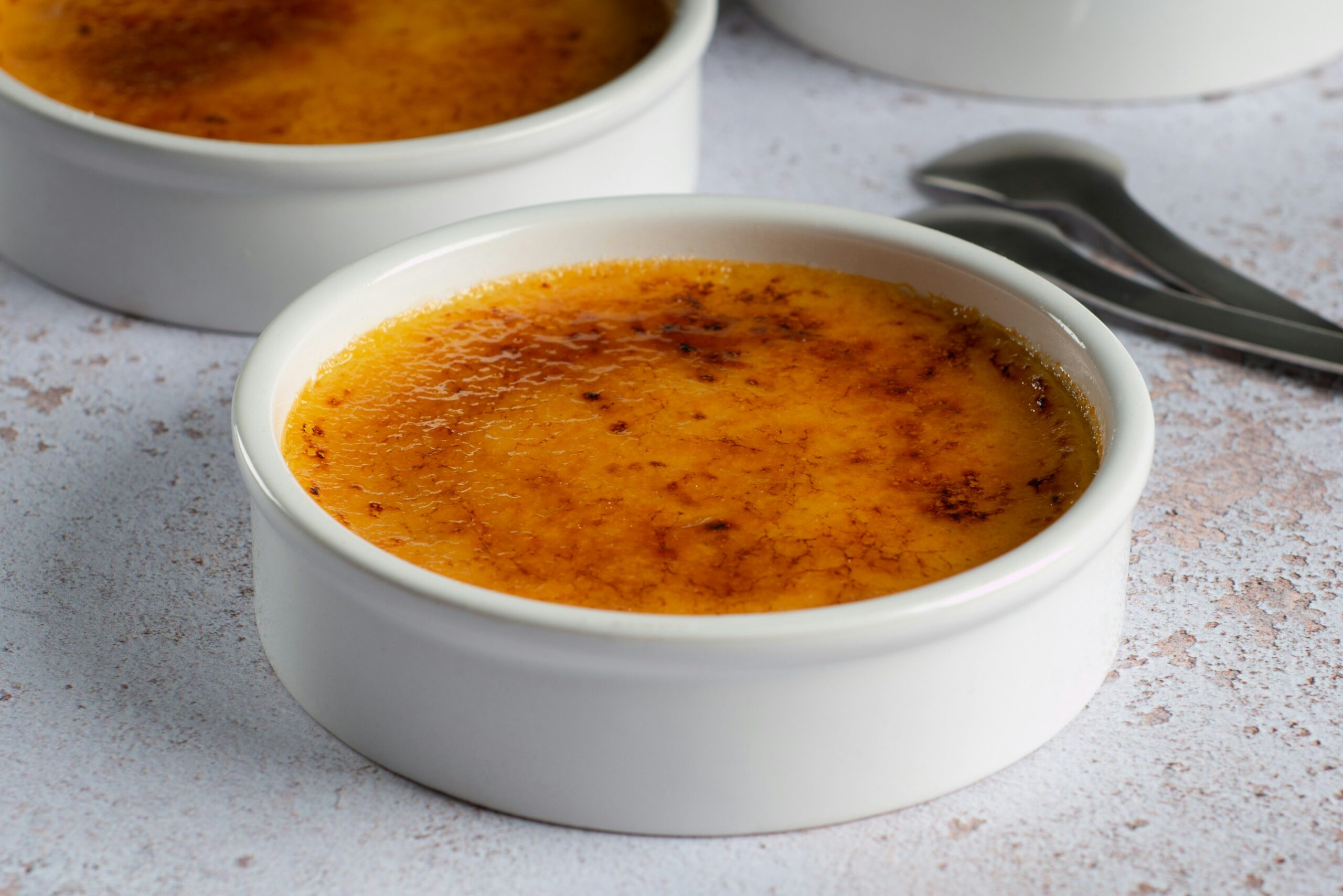
Remove the ramekins from the refrigerator 10 minutes before serving. If surface moisture or condensation has formed on the custard, gently blot it dry with a corner of a paper towel. Sprinkle approximately 1 teaspoon of extra-fine granulated sugar evenly across each surface, gently tilting and rotating the ramekin to form an ultra-thin, edge-to-edge crystalline sheet. Ignite a butane culinary torch and hold the blue flame 2 inches above the surface. Move the flame in continuous, steady circular patterns: the sugar will liquefy, bubble aggressively, and deepen into a rich amber lacquer. Allow the molten sugar to cool undisturbed for 3 minutes to crystallize into an impermeable, glass-hard shell.
Troubleshooting Common Crème Brûlée Errors
| Visual / Textural Defect | Biophysical Root Cause | Immediate Corrective Action |
|---|---|---|
| Grainy, Curdled Custard | Oven water bath ran dry, causing temperature to spike past 180°F (82°C). | Ensure water reaches halfway up the ramekin sides and pull when centers still wobble gently. |
| Soft, Chewy, or Sticky Sugar Crust | Too much sugar applied, or room humidity softened the hygroscopic caramel. | Use only 1 level teaspoon of sugar per ramekin and caramelize immediately before serving. |
| Lukewarm or Liquid Custard Core | Torch was held too close or for too long, melting the cold butterfat below. | Torch rapidly with high heat; ensure custards are chilled rock-solid (4 hours minimum) beforehand. |
| Porous, Pitted Custard Surface | Air bubbles were whipped into the mixture and baked onto the top. | Whisk gently without aerating, and pass the torch flame over raw ramekins to pop bubbles before baking. |
Storage, Serving Windows, and Thermal Integrity
Due to the hygroscopic chemistry of caramelized sugar, crème brûlée has distinct rules regarding storage and presentation:
- The 20-Minute Glass Window: Once torched, the caramel shell must be cracked and consumed within 15 to 20 minutes. Sucrose caramel is intensely hygroscopic (water-attracting); it will steadily draw moisture upward from the cool custard, gradually liquefying the crisp glassy shell into a sticky syrup.
- Advance Custard Preparation: Un-torched, baked custards can be stored in the refrigerator, tightly covered with plastic wrap touching the surface, for up to 4 days without sacrificing their velvety texture.
- Freezing Prohibited: Never freeze crème brûlée. Sub-zero ice crystallization punctures the fragile egg protein matrix; upon thawing, the custard will split, releasing water (syneresis) and ruining the delicate emulsion.
Frequently Asked Questions (FAQ)
Can I caramelize crème brûlée under an oven broiler?
While possible in an emergency, an oven broiler is strongly discouraged. A broiler radiates slow, ambient heat that warms and liquefies the entire custard before the surface sugar can caramelize. A butane torch delivers rapid, concentrated surface heat without penetrating the cold custard core.
Can I substitute half-and-half or whole milk for heavy whipping cream?
No. Milk and light creams contain significantly higher ratios of water to fat. Without the cushion of 36% butterfat, egg proteins will coagulate too quickly and curdle into watery, spongy curds rather than setting into a rich, creamy custard.
Why is shallow ramekin bakeware preferred over deep cups?
Shallow, wide ceramic dishes provide a higher surface-area-to-depth ratio. This maximizes the proportion of crunchy caramelized sugar in every spoonful while ensuring the custard bakes evenly without overcooking the exterior rim.
Nutritional Breakdown (Per Ramekin)
- Servings: 6 portions (5-ounce ramekins)
- Calories: 390 kcal
- Total Carbohydrates: 25 g
- Dietary Fiber: 0 g
- Protein: 4.8 g
- Total Fat: 31.2 g
- Saturated Fat: 18.5 g
- Cholesterol: 210 mg
- Sodium: 85 mg